To deal with the situation where China has a 'necklock' in the rare earth sector, the US and Western countries are eager to establish alternative rare earth supply chains. Kazakhstan, with its rich mineral resources, has become one of their targets.
According to Japan's Jiji Asia on June 19th, although Kazakhstan has mineral resources and mining technology, it still faces many difficulties in the most critical processing stage of rare earths.
From June 11 to 12, the Astana Mining and Metallurgy Conference was held in Astana, the capital of Kazakhstan. Just one day before, senior U.S. officials and representatives from the five Central Asian countries held a dialogue on critical minerals. U.S. Special Envoy Sergio Gor stated at the conference that the region "has not received the attention it deserves from the United States."
The United States is turning its attention to Central Asia, clearly as a response to China. China dominates about 70% of the global supply of rare metals and has established a complete system from mining to smelting, controlling more than 90% of the processing stages of rare metals worldwide.
Since 2025, China has successively introduced export control measures regarding rare metals and related technologies. Countries and regions such as the United States, the European Union, and Japan are actively seeking countermeasures. Some of these countries have turned their attention to Kazakhstan.
In April 2025, Kazakhstan announced the discovery of a large rare earth metal deposit in the Karaganda region of the country. The estimated total resource volume exceeds 20 million tons. If this is true, Kazakhstan will become the world's third-largest rare earth resource holder, after China and Brazil.
the Organization for Economic Cooperation and Development (OECD) stated that Kazakhstan, Kyrgyzstan, and Uzbekistan, these three Central Asian countries, have "significant" reserves of key raw materials. Of the 34 materials listed on the EU Critical Minerals List, Kazakhstan can export 21 of them.
However, analysts are skeptical about whether Kazakhstan can replace China.
Kazakhstan's rare earth industry is still in a very rudimentary stage. Said Kamal Aubakirov, key mineral analyst for Kazakhstan.
He stated that Kazakhstan is the world’s largest producer of uranium. The country has a sophisticated industry for processing copper, zinc, and other metals. It also has large mining companies and well-established infrastructure for processing certain elements. However, Kazakhstan lacks facilities for the large-scale separation of rare earth elements, and this process is extremely difficult.
Obarikov pointed out that although Kazakhstan may have vast reserves of rare earths, many of these materials are either found in tailings or in deposits that require further drilling and testing. The ‘true challenge’ lies in the processing and smelting stages in the middle of the supply chain.

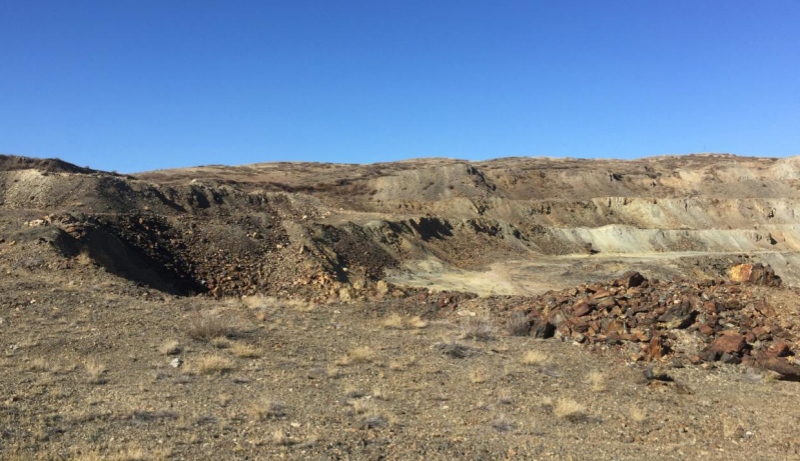
Kazakhstan North Katorp tungsten mine; Tawken-Samruk Mining Company website
In addition, the rare earth materials contained in Kazakhstani tailings typically come from uranium mining and Soviet-era mining activities. Processing these materials may produce radioactive by-products such as thorium, thereby increasing costs and environmental risks.
Umud Shokri, an energy strategist and senior visiting researcher at George Mason University in the United States, said that Kazakhstan's primary task is to understand its own resources.
"The region's most of the data still relies on outdated Soviet-era geological information." Schockri said, adding that Kazakhstan needs modern exploration and reserves assessments to earn the trust of commercial investors.
Although the rare earth industry in Kazakhstan still faces many difficulties, foreign investors have already flocked to the country.
The Kazakh Aluminum Company, which is associated with the Kazakh government, will begin producing the key metal gallium in the third quarter of 2026. According to an agreement signed with Mitsubishi Corporation of Japan at the end of last year, this batch of gallium, with an expected annual output of 15 tons, will be exported to Japan.
American investors are placing their bets on another key metal – tungsten. The joint venture established by Cove Kaz Capital Group, based in the United States, and Kazakhstan’s state-owned mining company Tavkent-Samruk is advancing the development of the Northern Katpar and Upper Kairakty mines. The estimated development cost is $1.1 billion. The US International Development Finance Corporation has issued a financing letter worth up to $700 million for this project.
Tungsten is an extremely hard metal, widely used in the manufacture of cutting tools, drills, and armor-piercing bullets. It is also used in electronic products and industrial machinery that must withstand extreme temperatures.
Obarikov believes that the breakthrough for Kazakhstan could lie in specific metals such as gallium and tungsten. In these areas, projects that are commercially viable can be matched with a wider range of buyers.
On the other side, Russia is also paying attention to the United States' activities in Kazakhstan. Mikhail Gatuzov, the Russian Deputy Foreign Minister, said in an interview with Russian media newspaper Izvestia in May this year that Moscow is concerned about the intensive activities of the United States in Central Asia related to key minerals and rare earths. He believes that the United States aims to remove Russia from the Central Asian countries that are part of Russia's traditional sphere of influence.
Chokri said that Moscow may exert diplomatic pressure and use transportation routes and security relations as bargaining chips. However, Chokri believes that “Russia cannot simply block everything.” If Western countries bring “real investment and processing technologies,” governments in Central Asian countries will interact with them, but they will also try to avoid open confrontation with Moscow.
However, analysts believe that the core of the rare earth issue remains China. It is unlikely for the world to escape China’s control. Most of the rare earths from Kazakhstan will eventually still be transported to China for processing. After all, China is nearby, and Chinese companies have a strong commercial presence in the region.
This region (Kazakhstan) can help achieve global supply diversification, but it cannot replace China. Xiaoke said this.