The West gave the keys to the medicine cabinets to China.
The British Financial Times published an article on August 12th, stating that the United States and Europe once led the era of antibiotics, but have gradually outsourced the production capacity necessary to maintain this system. Today, from common antibiotics to a large number of generic drugs, Western dependence on China's supply chain has become significant enough to be ignored.
The article’s author, Alar Dardzi, director of the Institute for Global Health Innovation at Imperial College London, writes that when Western patients receive antibiotics next time, they should ask where they come from. “The answer usually goes through China, and often more than once,” because Indian companies that supply large quantities of medicines to Europe and America also rely heavily on Chinese raw materials.
According to a report by the American Foreign Relations Association in 2026, China supplies about 94% of the key raw materials for amoxicillin worldwide. Amoxicillin is one of the most commonly used antibiotics in the world, and China accounts for nearly half of the global exports of antibiotic active ingredients. Among the drugs approved for marketing in the United States, nearly 700 drugs rely on at least one chemical raw material that is produced exclusively in China.
This report categorizes this dependence as a "threat equivalent to the challenge posed by rare earth elements," while also claiming there is potential for weapons development during a period of peace. Daryl Qi also highlights that, once a geopolitical conflict or new pandemic occurs, nations possessing the ability to produce key chemical raw materials will hold significant leverage.
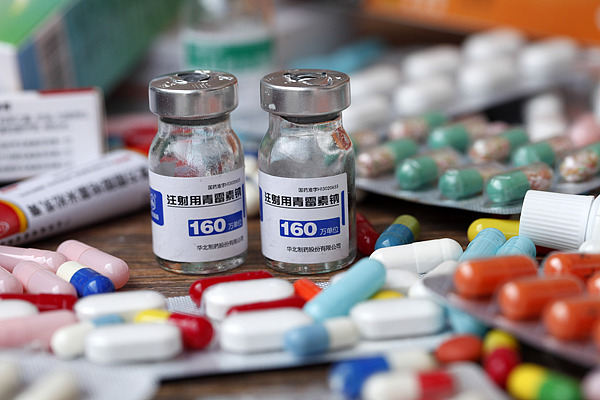
North China Pharmaceutical Co., Ltd.’s penicillin for injection, antibiotics, antibacterial drugs, and anti-inflammatory medicines. Visual China.
However, the article acknowledges that the West has largely caused its own situation to this day.
Antibiotics are a special category of goods: in order to slow down the development of resistance among bacteria, newer and more effective drugs need to be used with caution. Some drugs even need to be stored as a last resort. This means that sales are limited, and it is difficult for companies to recoup the high costs of research and development. As a result, capital flows towards more profitable areas such as cancer drugs and weight loss medications.
Major pharmaceutical companies such as Novartis, AstraZeneca, and Sanofi have successively withdrawn from antibiotic research and development. The American biopharmaceutical company Achaogen went bankrupt less than a year after launching a new type of antibiotic in 2018. According to statistics from the World Health Organization, there are currently fewer than 12 truly innovative antibiotics in the global research and development pipeline.
Meanwhile, China has not stopped moving forward. The Financial Times reports that China not only has a vast foundation in pharmaceutical manufacturing, but after about a decade of regulatory reforms, it now accounts for approximately one-third of the world's new drug development pipelines.
Facing this situation, Europe and the United States are seeking remedies. The UK has adopted a 'subscription-based' approach to purchase certain antibiotics, meaning that payments are no longer based on actual usage, but rather by paying a fixed fee each year, so that pharmaceutical companies can still make a profit even in cases where medication use is strictly controlled. The 'Pasteur Act' proposed by members of both political parties in the US also follows a similar approach, but it has not been passed by Congress yet.
Dalzi said that China is still behind the West in the discovery of new antibiotics, and the United States still has the opportunity to maintain its innovation advantage. However, he also said bluntly that the problem is that the West has not only outsourced production capabilities, but has also gradually ‘forgotten how to make, pay for, and use the things they have invented.’
He called on Europe and the United States to no longer consider antibiotics as ordinary goods that can be purchased wherever they are cheap, but rather to regard them as “key infrastructure” just like petroleum, semiconductors, and rare metals.