A hundred years ago, two American youths crossed the ocean to China. They worked at Dongwu University (the predecessor of today's Suzhou University), got to know each other, fell in love, and married in the U.S. Consulate in Shanghai. A hundred years later, their granddaughter Ellen Touchstone came from America to Suzhou, stepping onto the land where her ancestors lived and worked.
When I was a child, Shi Ailen liked to hide under the wooden table that my grandparents brought back from China. I never thought that one day I would come to this country. "When I was a child, I loved hiding under the table in the living room. That table was brought back by my grandparents from China, and it was filled with family photos."
In 1917, my grandfather, Kari Tachisong, came to Suzhou from Tennessee. He served as the English secretary and financial supervisor of Dongwu University, and also acted as a consultant for the university’s photography club. My grandmother, Mabel Allen Thomas, came from Pennsylvania and was appointed as the head nurse at Dongwu University’s first affiliated hospital. She led a team of nurses consisting of five to seven people. They lived in Suzhou for five years, deeply involved in local medical and educational endeavors.
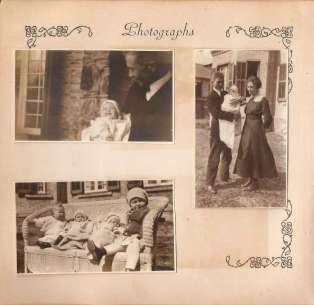
Interviewees provided photos of Shi Ailun's grandparents.
In 2012, when a recruitment advertisement from Xi'an Jiaotong-Liverpool University appeared before Shi Ailun, she realized that the workplace was the same city where her grandparents met and fell in love decades earlier. “When I found out that it was the same city where my grandparents met, married, had children, and lived together for five years, I decided to apply for this job. I think maybe this is a sign from heaven.”
During her more than ten years in Suzhou, Shi Ailen often visited gardens and embroidery shops in search of traces of her grandparents' life. "I think maybe my grandparents also came to these gardens when they were dating 100 years ago," she said. When she went to the archives to look through the yellowed annual records of Dongwu University, she couldn't hide her excitement when she found archival materials mentioning her grandparents.
During the pandemic in 2022, 57-year-old Shi Ailun put on a protective suit and became a volunteer at the nucleic acid testing site in Xihu Community, Suzhou Industrial Park. She helped foreign nationals register information and maintained order in English, German, and French. "A hundred years ago, my grandparents came to Suzhou from the United States... Today, by doing this volunteer work, I feel that I am doing what they hoped I would do," she said. "Although I am not a medical worker, being able to leverage my multilingual skills to assist in communication and do my part to help others makes me feel very valuable."
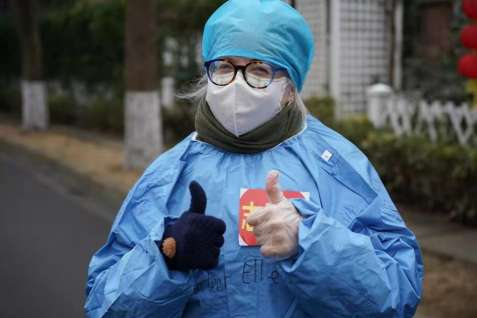
During the pandemic, Shi Ailen participated in community volunteer work. Photo provided by the interviewee.
Recently, Observer Network interviewed Shih Ailen, the deputy dean of the Global Business and Leadership College at Sophia University, and listened to her share her personal connection with China.
I have lived in China for 14 years now. All of this started in 2011 when a very good friend said to me, "I think you’re getting tired of living your life. Have you considered teaching in China?" These words made me start to seriously consider this possibility.
It seems to be a kind of fate. 109 years ago, my grandfather and grandmother came to China from the United States, specifically to Suzhou. My grandfather, Cary Tachisong, arrived in Suzhou in 1917 and worked at Dongwu University, which is now known as Soochow University. My grandmother, Mabel Ellen Tachisong, also came to Suzhou that same year and became the head of nursing at the First Hospital affiliated with Dongwu University. My name was named after her.
They came from very distant states in the United States, and they didn’t know each other in America. However, they met in Suzhou. In 1919, they married at the American Consulate in Shanghai. From that time on, our family began to exist. After living in China for five years, they left China in 1922.
In 2012, when I came to China, I was the first member of my family to return to China. It was also my first time visiting China. The first job I had in China was in Suzhou. I feel that this is like a kind of "cycle"—as if heaven is telling me to return to China just like my grandparents did.
During my university years, I studied in Vienna and Paris for each other semester, because I spoke German and French. That allowed me to see how wonderful it is when different cultures blend together. But I had never been to Asia before.
When I came to China, I brought two suitcases, a cat, and a backpack. Before coming here, I had no idea that China was such an advanced and modern country, nor did I know about its well-developed transportation network, or how fast the work efficiency here is—that is, what we call “China speed”.
Although I have an International Business MBA, my previous focus was on the European market, and I didn’t know much about many aspects of Chinese culture. When I arrived in China, I was truly amazed. What impressed me the most was China’s public transportation: it’s cheap, safe, and reliable. Taking the subway or bus costs only about 15 cents.
Secondly, I teach marketing. I noticed that this change is very important. When I first came to China, many students wanted to learn luxury marketing, with a focus on traditional brands from France, Italy, the United Kingdom, and even the United States. But around 2017 and 2018, when the "national trend" emerged, the performance of Chinese brands surprised me greatly. It was no longer just about "Made in China," but also about "Chinese design." This change also extended to areas such as the modernization of traditional Chinese medicine and the integration of traditional Chinese and Western medicine.
I signed a three-year contract with the university, so I wanted to stay there for at least three years. But I really had no idea what would happen. I didn’t expect to love China and Suzhou so much, nor did I expect to make so many Chinese and international friends here. I never thought there would be so many opportunities, including those through volunteer work in Suzhou communities. And now, I’ve been here for 14 years.
Please allow me to correct something: I am not a “new citizen of Suzhou”. Due to my family background, I consider myself to be an “authentic Suzhou native”. If my grandparents hadn’t come to Suzhou, I wouldn’t exist.
During the COVID-19 pandemic, I felt that there was a lot in common with the work my grandparents did a hundred years ago, especially with my grandmother. I usually wear a bracelet with a bead that I found from her jewelry box, so that she and her powers are always with me.
She brought Western nursing techniques to China and tried to combine them with traditional Chinese medicine. Recently, I read the diary of a colleague of my grandfather. In March 1918, during another major epidemic around the world, he wrote that he went to my grandmother’s house to make masks, in order to protect people from the epidemic. Thinking about this, I realize that 100 years ago, my grandmother cared for others here; 100 years later, when another major epidemic strikes, I am helping to protect Suzhou.
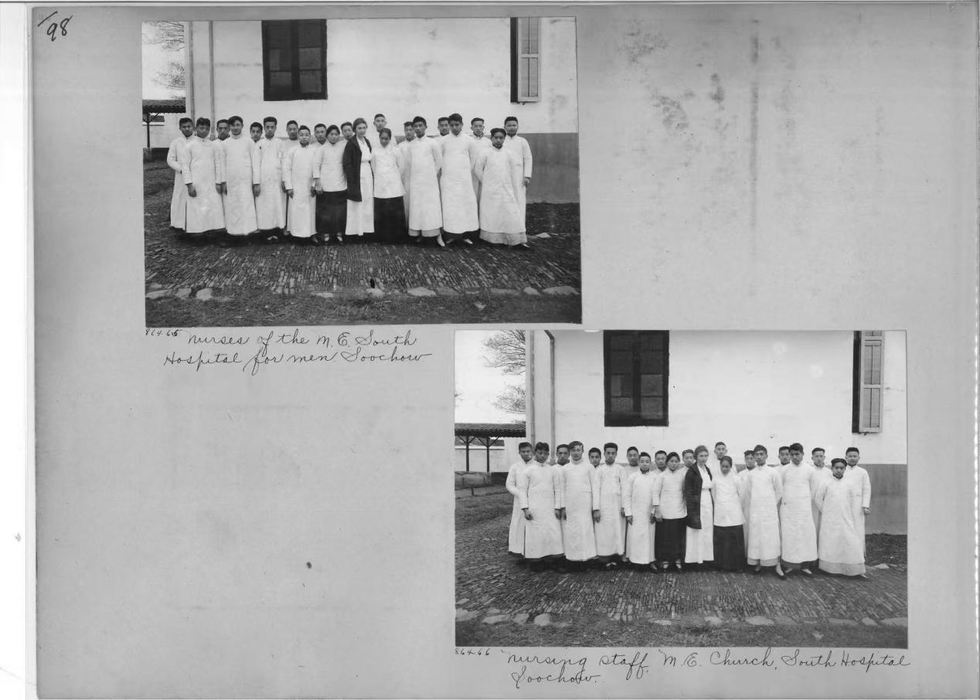
Xie Ailan's grandmother was photographed in Suzhou at that time. Photo provided by the interviewee.
When I put on that 'white' protective suit and stand in a community in Suzhou, helping one foreign resident after another complete the procedures, I suddenly feel that I am no longer just an observer of this city. Through the masks and face shields, I can't see each person's face clearly, but I can feel that I am truly standing together with the people of Suzhou.
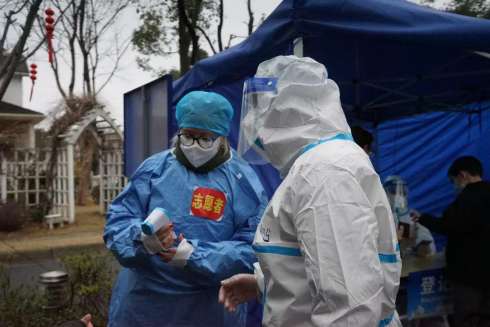
During the pandemic, Shi Ailen served as a volunteer. Photo provided by the interviewee.
West Liverpool University International Business School (IBSS) was seeking EQUIS accreditation at that time. I was trapped in Dallas, USA due to the pandemic. As the deputy dean, I had to attend many online evaluation meetings. An evaluation expert said he was impressed by our work in areas such as sustainability and International Women’s Day. Then he asked, “Which of these initiatives were student-led?” I suddenly realized that this might be a missing link in our work.
In October 2020, after returning to China, I realized that my mission was to let students lead sustainability efforts. In January 2021, I invited three students to my office to introduce this initiative. It was originally called “15 Days of 15 Ways,” created by the United Nations Development Programme. It uses a knowledge-sharing license and can be adapted as long as it is credited.
I said that we have 14 weeks in a semester. Why not change it to “15 weeks, 15 ways”? This way, the entire spring semester can be covered. Students will be divided into groups, with each group responsible for designing activities for one week. These 15 ways refer to the 15 most effective methods for ordinary people to reduce their carbon footprint.
Two of the three students immediately responded, and they recruited more students to create their own brand, “Sustainable Future Talents”. I meet with them weekly to discuss plans and give them a budget. What I learn from them is no less than what they learn from me. Later on, many students who majored in accounting, economics and finance, marketing decided to pursue graduate studies in sustainability and environmental science. Some of them are now already working in related fields.
In the first two years, all members were Chinese students. Later on, there were also international students from countries like Malaysia, Indonesia, and Thailand who had Chinese ancestry, as well as exchange students from the BI Business School in Norway.
I believe that the task of saving the world depends on them. This is why I take my role seriously, because our world has many wonderful things, but there are indeed some very difficult problems to solve. The United Nations refers to these as 'intractable issues', which are the 17 Sustainable Development Goals. Since their proposal in 2015, there has been little progress over the past nine years.
Young people must cross borders, disciplines, and economic classes to truly come up with viable solutions. They need systematic thinking and the ability to handle situations in a VUCA (volatile, uncertain, complex, ambiguous) environment. They must have resilience and not give up when faced with challenges. I'm full of hope working with today's young people.
I have many concerns, because I understand how important effective communication is. The world we live in today still has many problems that require cooperation to be solved. For example, the problems in the United States will not stay there; they will spread to other places. Similarly, this is true for China. Therefore, we need dialogue and communication to address these issues.
In my daily life in China, I constantly strive to be a role model for "typical Americans". I have great respect for China and am curious about its culture. I believe that communication between people is very important. Many of my American friends in China are working hard to set a positive example for Americans and encourage more Americans to come to China. China has proposed the "5-Year, 50,000" initiative (inviting 50,000 American teenagers to study in China over five years), and I am helping the government of Suzhou to promote this initiative. Only by allowing more Americans to come to China and see the real China and its culture can we dissolve misunderstandings between each other.
Secondly, I believe the information gap between the two sides is a major challenge. Before the 'Western Refugees' incident, social media platforms in China and the United States were very isolated from each other: China had WeChat, Douyin, and Bilibili, while the United States had Facebook, Instagram, and Snapchat. Later, when the 'Western Refugees' started using REDnote, they saw the daily lives of Chinese people and realized how friendly the Chinese are. REDnote and TikTok operate differently, so they had to learn how to use these new platforms, and Chinese netizens were very patient in helping them.
This bottom-up sharing by ordinary people can correct many misunderstandings. For example, many Americans now consider Chongqing to be the place they most want to visit because they have seen pictures of the subway that runs through buildings in Chongqing online. They think Chongqing is too futuristic. This is the power of ordinary citizens to share their lives on social media.
Overall, I believe the biggest obstacle to mutual understanding between China and the United States is not a lack of common interests, but the failure of both sides to see each other's real lives. The way to resolve this issue is to allow more Americans to visit China in person, and also to encourage more ordinary people to share their daily lives through social media. Once there is real contact between people, misunderstandings will gradually fade away, and respect will naturally grow.