In the past two years, public anger towards data centers near their homes in the United States has grown increasingly intense. After the midterm elections, a group of Democrats came to power. During their campaign, they promised to take control of these “energy-consuming monsters”.
According to a report by The Associated Press on November 7, artificial intelligence (AI) data centers have suffered a blow during the midterm elections, and tech giants may face liquidation. In the future, AI giants and data center developers are likely to face stricter regulatory environments.
Data center regulation itself did not appear on most ballots, nor was it a topic of greatest concern for the majority of voters.
But during the midterm elections, a strong stance towards data centers was included in the campaign platforms of many candidates. This includes Democrats who aim to end the Republican control of governorships for long periods—states like Texas, Ohio, Georgia, Nevada, and Iowa, where there are many data centers located.
Skepticism about data centers, combined with concerns about electricity prices, often gets intertwined with debates over whether people can afford to live in such environments. This latter issue is a key topic during Democratic elections.
In Texas, Clayton Tucker became the first Democrat to be elected as the state's agriculture commissioner since 1986. He said his opposition to data center development was key to his victory. Ranch owners are worried that data centers will threaten their already dwindling water resources.
"There's a saying in this place, 'Whiskey is meant for drinking, water is meant for thieving'," said Tak. "That's just the way it is."
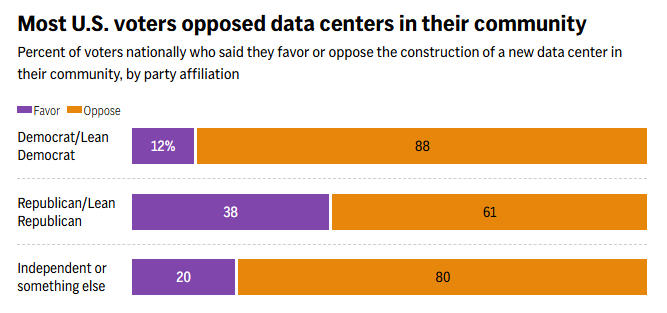
Regardless of party affiliation, most Americans oppose the construction of data centers near their homes. Map by The Associated Press
According to data from the advertising monitoring agency AdImpact, campaign teams, large and small, spent over $380 million on television ads related to data centers. In this area, Democrats’ spending is more than three times that of Republicans.
The sweeping victory of Democrats could have a profound impact on data centers. In addition to taking control of Congress, they have also overturned the governorships in several states and gained full control over six other states: Arizona, Wisconsin, Minnesota, Pennsylvania, Nevada, and Michigan.
"Data Center Watch" states that it tracks winners of congressional and gubernatorial elections, finding that the vast majority support stricter regulation on data centers, even supporting a pause in new construction. At the governor level, in 34 races where the Associated Press has declared winners, 32 supported tighter regulation or limits, with 12 specifically calling for bans or suspension of construction.
During the campaign period, Wisconsin's elected governor and Democrat David Schrier initially opposed any suspension orders. Later, he expressed support for suspending new construction and advocated for canceling the state's sales tax exemption for data center operators and developers.
In an interview with the Associated Press, Croly said that the measures he is considering include asking developers to disclose more information about water and electricity usage; ensuring community support before starting the project; and letting electricity users and taxpayers not have to bear the energy costs associated with the project.
OpenAI released a framework on Thursday, outlining new commitments to the communities where data centers are located. The company stated that they are asking federal, state, and local policymakers to establish “clear rules on how the industry should be built.”
The industry association ‘Data Center Coalition’ also expressed the same sentiment: Developers must continue to gain the trust of officials and communities. Dan Diorio, an official with the coalition, said that the industry is aware that many winners of the midterm elections have vowed to impose a suspension.
"We should anticipate that they will fulfill these promises, but doing so will have real consequences," Dioleao said in an interview. Consequences may include the community of data centers being unable to receive tax revenue, as well as companies receiving payments from technology firms not obtaining it. He also said that data centers are driving broader economic expansion, thus encouraging investment in local manufacturing industries.
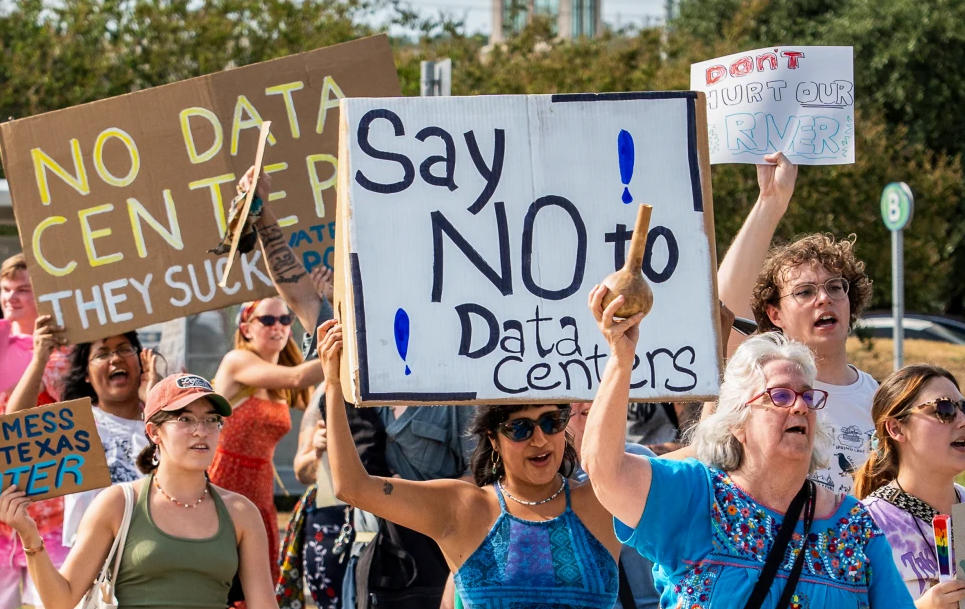
American citizens protest the construction of data centers
The results of the mid-term elections have added more challenges to the stock market, which has been soaring due to the AI boom.
On Thursday, the Nasdaq index, which consists mainly of AI-related and other technology stocks, fell 11% from its historical high. Market sentiment is concerned that data center construction may slow down, as interest rates are rising.
Artificial intelligence (AI) data center construction is driving a significant portion of the US economy's growth. If it slows down, the chill could spread to a wider range.
Morgan Stanley stated in an analyst report that a decisive victory for the Democrats means "there is a stronger expectation of limitations on data centers." Under new state-level regulations, this could "divide the country into two categories: those who welcome new data centers and those who do not."
The report states that electing Gina Innohos as the governor of Texas is “one of the most important elections” for data center development. Innohos promised to block data center licenses if the projects were not beneficial to Texans or their residents. She defeated Republican Governor Greg Abdo, who had previously referred to Texas as a “core area for AI development.”
According to analysis by Redbud Consulting, a polling organization, in local elections, voters across the country overwhelmingly voted in favor of restricting data centers.
Redbud tracked 47 referendums in 12 states and 44 municipalities, including 21 in Ohio, 8 in Maine, 7 in Illinois, and 4 in Kansas. The results showed that in 45 of the polls that had completed their voting processes, restrictions were approved in 44 cases.
According to Associated Press data, regardless of whether they live in red or blue states, most voters (about three-quarters) oppose the establishment of new data centers in their neighborhoods.
In some traditional red states, there is a slight advantage in support for this initiative, such as Wyoming, West Virginia, Louisiana, and Mississippi. In Texas, where the race is between "red flipping blue," voters in the Senate election also tend to oppose the construction of new data centers locally.
But the survey also shows that this issue did not generate significant support among voters in this election. Approximately one-fourth of American voters said that AI data centers are “very important” for their decision to vote for congressmen. This proportion is much lower than those who consider government corruption or living costs to be “very important”.
According to a report by Jones Lang LaWinson (JLL), by 2030, Texas will overtake North Virginia as the world's largest data center market. However, during the campaign, Yinohosa attacked Abott, claiming that he had paved a red carpet for data centers.
The Republican Stephen Sanders co-founded a group that opposes data centers. He said that Texans are particularly sensitive to this issue, as people always say that data centers could threaten the state’s electricity and water resources.
"I will say that the data center is indeed on the ballot," Sanders said.